Are We Welcoming People into Our Version of Church, or Into the Church Jesus Prayed For?


I have recently been reading and listening to Francis Fukuyama’s The End of History and the Last Man. It is one of those books that makes you stop and think, not necessarily because you agree with everything the author argues, but because some of the questions remain with you long after you have put the book down. Fukuyama is primarily concerned with politics, liberal democracy and the direction of human history. Yet one idea caught my attention for a very different reason: the deep human desire for recognition.
Fukuyama argues that human beings do not live by material wellbeing alone. We want more than security, prosperity and comfort. Somewhere within us is a desire to be recognised, to know that we matter, that our dignity is acknowledged, that our contribution is valued and that our voice counts. As I reflected on this, I found myself thinking less about political systems and more about the Church, particularly churches seeking to become genuinely intercultural communities.
Over the last few decades, many churches in Britain have become increasingly culturally diverse. This is something worth celebrating. Walk into some churches today and you may encounter people whose family histories stretch across Africa, Asia, the Caribbean, Europe, Latin America and Britain. You may hear different accents and languages, see different styles of dress and occasionally experience worship, food and celebrations reflecting several cultures. From the outside, such a church can look wonderfully intercultural. Yet beneath this visible diversity lies a more searching question: Is everyone simply present, or does everyone genuinely belong?
There is a significant difference between presence and belonging. We can invite people into the room without allowing them to influence what happens in the room. We can celebrate people’s food while never listening seriously to their theology. We can enjoy their worship while never trusting them with leadership. We can place culturally diverse faces on our websites while the important decisions continue to be made by the same kinds of people. This is where Fukuyama’s discussion of recognition became particularly thought provoking for me.
Representation matters. If people cannot see themselves within a community, questions about belonging will inevitably arise. But representation cannot be the destination. A church may have people from many cultures sitting in its congregation while its leadership, decision making, worship, theology and organisational culture continue to reflect predominantly one cultural tradition. The question therefore has to move beyond “Who is in the room?” We must also ask, “Who shapes the room?”
Who makes the important decisions? Whose voice carries authority? Who determines what good leadership looks like? Whose worship style is regarded as normal? Whose understanding of hospitality, discipleship, time, authority and community shapes church life? Who is continually expected to adapt, and who rarely has to? These can be uncomfortable questions, but genuine intercultural transformation rarely happens without the courage to ask uncomfortable questions.
Recognition, however, should not be confused with agreement. Christians will continue to hold different theological convictions, cultural assumptions and experiences. Genuine intercultural community does not require us to erase those differences or pretend they do not matter. Recognition means something deeper. It means that I can encounter someone whose culture, experience or perspective differs from mine and still recognise the image of God in them. I can listen without immediately becoming defensive. I can disagree without diminishing their dignity. Perhaps most challenging of all, I can allow what I hear from them genuinely to influence me. Listening that never leaves open the possibility that I might change can easily become another form of politeness.
This is also where the Christian story takes us beyond Fukuyama. Human dignity is not ultimately something society gives us. It comes from God. Genesis tells us that humanity is created in the image of God. Before nationality, ethnicity, social class, education, status or achievement, there is Imago Dei. That truth radically changes how Christians should encounter one another. I do not recognise your dignity because you have earned it. I do not recognise your dignity because we share the same culture. I do not recognise your dignity because you agree with me. I recognise your dignity because you bear the image of God.
The New Testament takes this further by presenting the Church as a community in which people who might ordinarily have been separated by ethnicity, social status, culture and history are brought together in Christ. Difference does not disappear, nor should it. But difference is no longer supposed to determine who belongs, whose contribution matters or who has access to the life of the community.
This brings me to the prayer of Jesus in John 17. Jesus prayed that His followers would be one, and He connected their unity with the credibility of their witness to the world. Christian unity, therefore, is more than an internal church matter. The way we live together says something about the God we proclaim. In communities increasingly wrestling with cultural tension, migration, racial division, political polarisation and competing identities, the Church has an extraordinary opportunity to demonstrate another way of living together.
But this will require much more than bringing different people into the same building on a Sunday morning. It requires relationships deep enough for people to know one another beyond cultural labels. It requires listening, hospitality and humility. It requires mutual influence and shared responsibility. It requires leadership structures in which people are not simply represented but trusted to contribute to the direction of the community. And sometimes it will require those who have traditionally shaped the room to make genuine space for others to help shape what comes next.
This is one of the reasons we are increasingly talking within WEAVE about moving beyond representation towards belonging, mutual influence and shared leadership. I see a journey emerging: Presence → Relationship → Recognition → Belonging → Mutual Influence → Shared Leadership → Shared Mission → Visible Unity
Presence matters because we must first encounter one another. Relationship takes us beyond assumptions and stereotypes. Recognition enables us to see and value one another. Belonging means I no longer experience myself merely as somebody else’s guest. Mutual influence means our encounter begins to change all of us. Shared leadership means responsibility and authority are genuinely carried together. Shared mission turns our attention beyond ourselves towards our communities. And visible unity allows those communities to encounter something of the reconciling work of Christ through the way Christians live together.
This is much harder than simply becoming culturally diverse. Diversity can happen because the neighbourhood changes. An intercultural congregation can emerge because migration patterns change. But becoming a genuinely intercultural community requires intentional formation. It asks something of everyone. It requires us not simply to celebrate difference, but to consider how encountering difference might change us.
Fukuyama’s The End of History and the Last Man raises a fascinating question about what happens when human beings become comfortable and the great struggles that once gave life meaning appear to disappear. Reading it caused me to ask a different question about the Church: Have we sometimes become comfortable with being together without undertaking the harder work of becoming one?
Perhaps we have learned how to welcome one another without learning how to need one another. Perhaps we have celebrated diversity without allowing difference to transform us. Perhaps we have invited people into spaces without asking whether they have any meaningful part in shaping those spaces. Perhaps our greatest challenge is no longer simply getting different people into the room, but discovering what happens when everyone in the room is recognised as someone through whom God may speak, lead, challenge and contribute.
This leaves me with a question that continues to challenge my own thinking:
What if becoming one requires more than welcoming one another into the room? What if it requires allowing one another to shape the room?
For me, this is increasingly at the heart of the WEAVE journey. We are not pursuing sameness. We are not asking people to abandon their culture, history or convictions. We are asking whether, through Christ, we can become communities where difference encounters difference without fear, dignity is recognised, relationships deepen, belonging becomes real, leadership is shared and our common life becomes a visible witness to our neighbourhoods. That is more than intercultural representation. It is the demanding, beautiful work of learning to belong to one another. Perhaps that is part of what it means to become the Church Jesus prayed for.
Continuing the Conversation in Birmingham
These questions cannot be resolved by one article, one conference or one conversation. They require us to sit together, listen to one another, pray together, learn from our different experiences and consider honestly what needs to be different in our churches and communities.
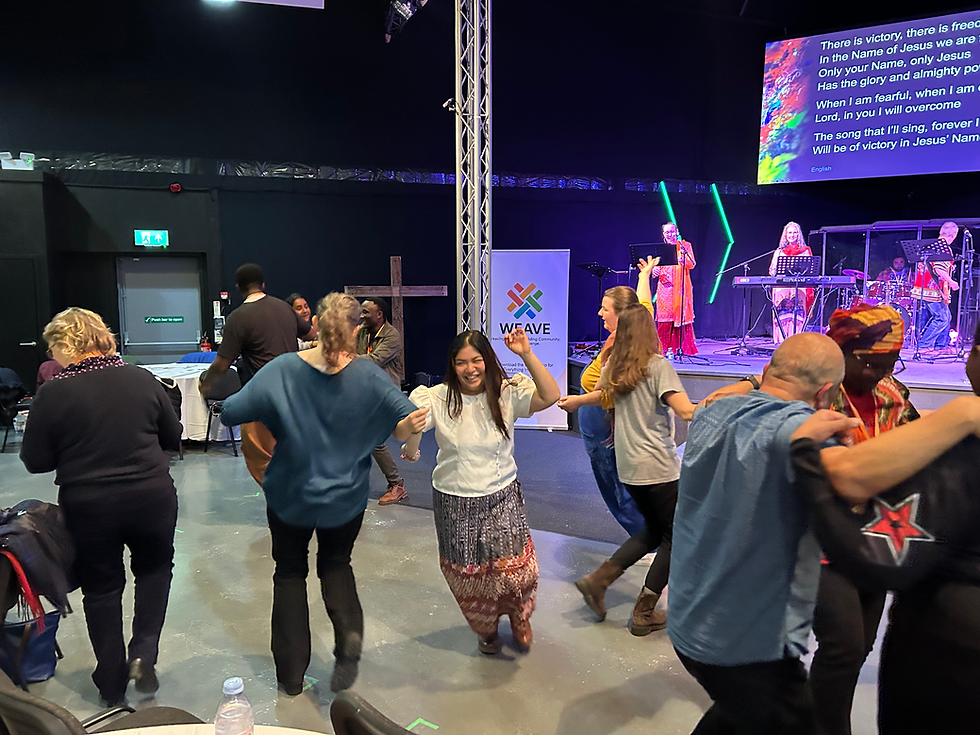
That is why I would like to invite you to join us at the WEAVE Birmingham Gathering, 3 to 4 February 2027, at The Dream Centre, Birmingham, as we continue this conversation around the theme, “Beyond Intercultural: Becoming the Church Jesus Prayed For in Our Communities.”

Comments