Weaving a Bigger Story of God


Across the Western world, and in countries shaped by its mission history, many believers grew up hearing these treasured words:
“God changes the world one heart at a time.”
That is true. When God changes a heart, life begins again.
But if we stop there, something important is missing.
A person can love Jesus yet still avoid or hate people who are different.
A church can be full of faithful believers yet remain disconnected from its neighbours.
Hearts can change, but walls can still stand.
Individual transformation does not automatically lead to unity, peace and shared healing. Without community change, a changed heart may simply make someone a nicer version of themselves, without helping to heal a broken society as we see today. The Gospel Jesus preached is bigger. He came to restore relationships, communities, and cities, not just individuals. The Kingdom of God is personal, but it is also deeply communal.
Sometimes we forget this wider picture because we read the Bible through only one cultural lens.
In my book Cultural Intelligence in Church and Ministry, I share an example from researcher Mark Powell that shows how culture shapes our theology and ministry.
He gathered Christians from the United States, Russia, and Tanzania and told them the parable of the Prodigal Son. Afterwards, he asked a simple question:
Why did the son end up living with the pigs?
Their answers were very different:
· Americans said: “Because he squandered his money.”
The focus was on personal responsibility. An individualistic and capitalist culture.
· Russians said: “Because there was a famine in the land.”
The focus was on external hardship. A history of famine and poverty
· Tanzanians said: “Because no one helped him.”
The focus was on community care and Ubuntu — “I am because we are.”
So which answer is right?
Let’s check the text (Luke 15:13–15):
He wasted his wealth…
Then a famine came…
And no one gave him anything…
So, he ended up feeding pigs.
All three are correct — but each is only part of the story.
Each group saw the part that made sense in their culture:
· America: the individual failed – blamed the individual
· Russia: circumstances overwhelmed - blamed nature
· Tanzania: the community failed to care
Culture shapes what we notice in Scripture.
Culture shapes how we interpret people’s struggles.
Culture shapes how we love, disciple, and support others.
But this parable is ultimately not about:
who is to blame or what caused the fall
It is about the Father - who runs, embraces, restores, and celebrates.
All theologies are contextual.
And when cultures learn from one another,
we see more of God’s heart.
The Danger: When Private Faith Becomes Public Power
When Christians embrace a theology focused only on personal faith and individual salvation, rather than communal restoration, several risks emerge:
· Faith becomes private - separate from society, culture, or the common good.
· Believers may judge outsiders rather than empathise or build bridges.
· Churches may concentrate only on spiritual life and ignore social justice, structural injustice, or community healing.
This mindset can feed movements like Christian nationalism - where faith is merged with political power, national identity, or cultural dominance.
In such a framework:
· Saved souls become the centre.
· Nonbelievers or outsiders become threats or others.
· Faith becomes a tool to assert identity or influence institutions, rather than to foster humility, mercy, justice, and love across boundaries.
When theology is individualistic and culturally narrow, it can easily justify exclusion, division, and even dominance masked as “spiritual righteousness.”
What This Means for Weave
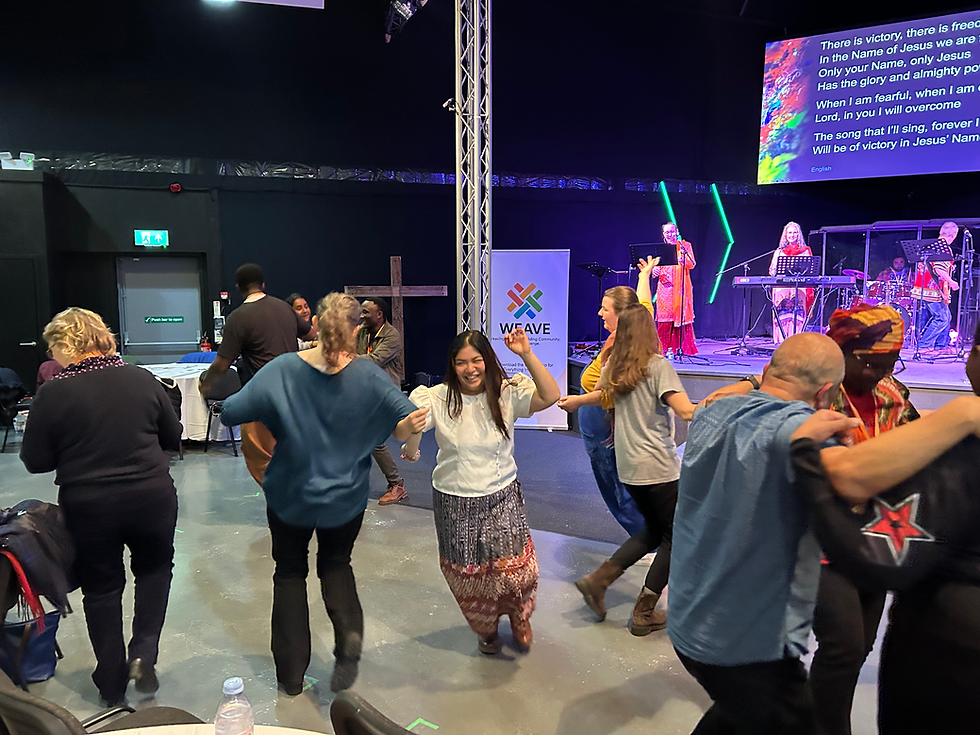
This is why Weave exists.
Because unity is not everyone seeing the world the same way.
Unity is everyone seeing God more clearly together.
· Some of us see the Gospel as personal transformation.
· Some see the need for social healing.
· Some feel the call to community and hospitality.
The fullness of the Gospel includes all three.
When we only trust our cultural interpretation, we make the Gospel too small.
We create blind spots in our discipleship, our pastoral care, and in how we engage society. When faith becomes a closed club - defined by identity, politics, or culture - we lose sight of Jesus’ heart to love our neighbour as we love ourselves
But when we listen to believers from every culture,
the Church becomes wiser, richer, stronger.
God’s vision becomes clearer.
Shalom becomes possible.
Our Hope
We are a movement for a bigger Gospel - where every culture brings its God’s gift, every voice has value, and Jesus is revealed through all of us.
We are learning to see the Bible together.
To break down walls.
To heal what is broken.
To celebrate what God is weaving in our cities:
Dignity restored.
Relationships healed.
Communities renewed.
This is our challenge.
This is our hope.
This is Weave.

Comments